
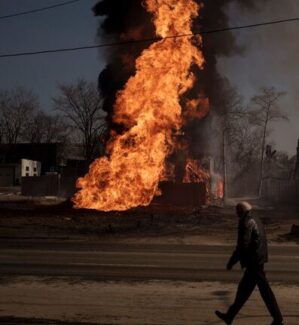
Spencer notes that military equipment is by and large ‘reciprocally destructive’, that is to say, it destroys and is itself destroyed. A missile destroys a ship and is itself destroyed, likewise for bombs, shells, and bullets.
Other military equipment is worn out and broken in use. Gun barrels, rifle actions, tank tracks, engines, clutches, springs, coachwork, tyres, instruments, are worn out or broken. Tanks are reduced to smouldering hulks, aircraft are shot out of the sky and land in smithereens, ships are sent to the bottom of the ocean; lorries are strafed or blown to pieces with mines.
This is all besides the destruction wrought upon the target — buildings, roads, railways, bridges, harbours, power installations, fuel refineries, factories, machinery, warehouses — bombed, blown to bits, consumed with fire; the material basis of civilisation, wrecked.
Then there is much energy expended in movement and transportation. Vast quantities of fuels and propellants are burned. Armies of men must be fed, transported, kitted out, accommodated, and repaired in field hospitals where possible. Ships ply the oceans and freight-planes ride the skies to carry thousands and thousands of tonnes of the material needed for warfare.
Where in the war-making is the concern over carbon emissions?
Where in all this manufacturing of war material, transportation of war material, and destruction of war material, is the aching, urgent, and prominent carbon-concern from government that intrudes into every aspect of the ordinary citizen’s life?
At work when Spencer prints a sheet of A4, the printer informs him of how much carbon his workplace has emitted by printing sheets of A4. He is nagged to cycle and walk. He is urged to turn down his thermostat and to dwell in a cold sitting-room. He is forced to buy expensive low-energy light bulbs. He is harrassed to fit thicker insulation and attach solar panels to his house. The hills are festooned with wind-turbines. At every turn he sees cars, refrigerators, washing machines, laptops, commercial vehicles, clothing retailers, municipal dumps, cafetrias and trinket-shops boasting of their sustainability. There is everywhere great concern over the carbon footprint of the UK, except when it comes to the carbon footprint of war.
In the UK support to Ukraine: factsheet linked below, there is much money pledged to a ‘green’ and ‘sustainable’ rebuilding of Ukraine’s pulverised power infrastructure. There is however not one word about the carbon emitted due to the UK’s participation in the Coalition of the Willing and our involvement in Ukraine. Not one word.
It is almost as if the explosions and the burning and the destruction and the repair of the destruction and the manufacture of ammunition, missiles, bombs, war-machinery, and the vast numbers of roaring large-capacity diesel engines and jet motors have all suddenly become carbon-free and emit no carbon-dioxide at all.
When it comes to carbon footprint, it is belt-tightening for citizens, but unlimited war-splurge for government.
Below you will find links to some facts and reporting on UK input to the war.
The ‘Coalition of the Willing’ has pledged 90 billion euros of support for Ukraine. UK is a participant in the Coalition of the Willing.
The expense to the UK of supporting Ukraine is laid out in this government publication, the UK support to Ukraine: factsheet, of 24th July 2026.
The extent of the military contribution is set out in this government press release, of 18th June 2026. This includes ‘150,000 Ukrainian-produced drones and over 350 air defence missiles and radars’. That Storm Shadow cruise missiles have been supplied to Ukraine by the UK is public knowledge, but the numbers are a state secret.
To these stocks can be added anti-tank missiles, anti-ship missile systems, anti-bunker missiles, armoured vehicles, and artillery pieces. This article by Mata and Sommerlad in the Independent (16th May 2023) details the flow of military hardware from the UK to Ukraine as long ago as the Spring of 2023.
